No Other Choice is an unhinged descent into despair as the male ego is shattered & challenged and boy did Lee Byung-hun get the assignment.

One of the biggest pandemics of the 21st century is the constant job loss of millions of qualified, and even overqualified, workers. Replaced by machinery, and more recently A.I., leaving families in debt and forced to readjust despite years of loyalty and good work. Which has forced legendary filmmaker Park Chan-wook to ponder the questions: What does despair look like? How does it manifest?
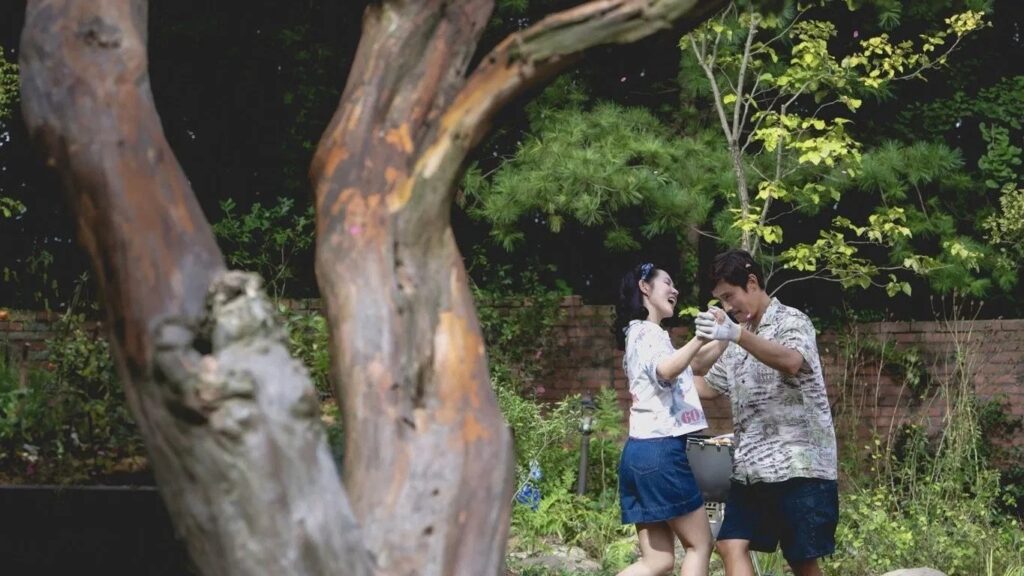
This is the thesis of his latest work: No Other Choice. Where Man-su (Lee Byuyng-hun), a specialist in paper manufacturing with 25 years of experience and devoted father living with his loving family and two dogs in his idyllic childhood home, is so satisfied with life that he can truthfully tell himself, “I’ve got it all.” He happily passes his days with his wife Miri (Son Yej-in), sharing meals in the garden and carefully working on his bonsai and planting his garden, but Man-su is suddenly informed by his company that he has been fired with the words: “We’re sorry. We have no other choice.”

Feeling as if his head has been mercilessly severed by an axe, Man-su vows to find a new job within the next three months for the sake of his family but despite his firm resolve to turn his life around, Man-su spends over a year drifting from one job interview to another, eventually working in a retail store where he’s clearly overqualified, overworked and overwhelmed. Reaching his breaking point when he finds himself in danger of losing the very house he struggled so hard to buy.
Desperate, he visits Moon Paper unannounced and tries to hand over his CV at the threshold of a bathroom, only to be even more humiliated by a line manager. Man-su, knowing he is beyond qualified to get the position at Moon Paper, comes to a certain decision: If there is no opening for him, he’ll just have to get hired by creating an opening. An opening he is willing to create himself, by eliminating the competition.
While on paper that could read like a dark thriller, which would not be new territory for Chan-wook, but what is certainly a dark descent into the lowest pits of psychopathy, never becomes a retribution power fantasy brought to life but instead is a macabre comedy about the fragility of the male ego in its most desperate form. Chan-wook is vehemently not encouraging this behaviour but rather ridiculing it to make a point.
The sales pitch is simple: What if a devout family man, in his despair to provide for his loved ones, becomes the world’s most incompetent hitman?
The juxtaposition between seeing a devout family man succumb to his darkest and most egotistical impulses become the most incompetent and frightened of hit man is nothing short of comedic genius, a story played completely straight that could be read as something out of The Naked Gun (complimentary). Yet, Chan-wook unrelentingly tense direction keeps us just enough on edge to keep guessing if the comedic tone is just a façade, uncompromisingly tiptoeing between how pathetic Man-su has become but always finding moments to illustrate his humanity, mostly by showcasing the dedication to his family as motivation despite his morbid actions.
Surprisingly, the two contrasting tones never compromise each other and Lee Byung-hun’s carefully calibrated performance walks the tonal tight rope flawlessly, in what is essentially a comedy of errors where he accidentally falls into successes. Byung-hun is clearly never afraid to laugh at himself, his physical comedy just as funny as his line delivery. What makes him compelling is how at his core, Man-su’s a man whose identity has been taken away from him, as both a manager, something he has dedicated his entire life to, and as a father and provider; he’s always been someone his family can depend on and until now there was never a reason to question it, but once without the job he dedicated a quarter of his life to, who is he? Who can he be if not that?
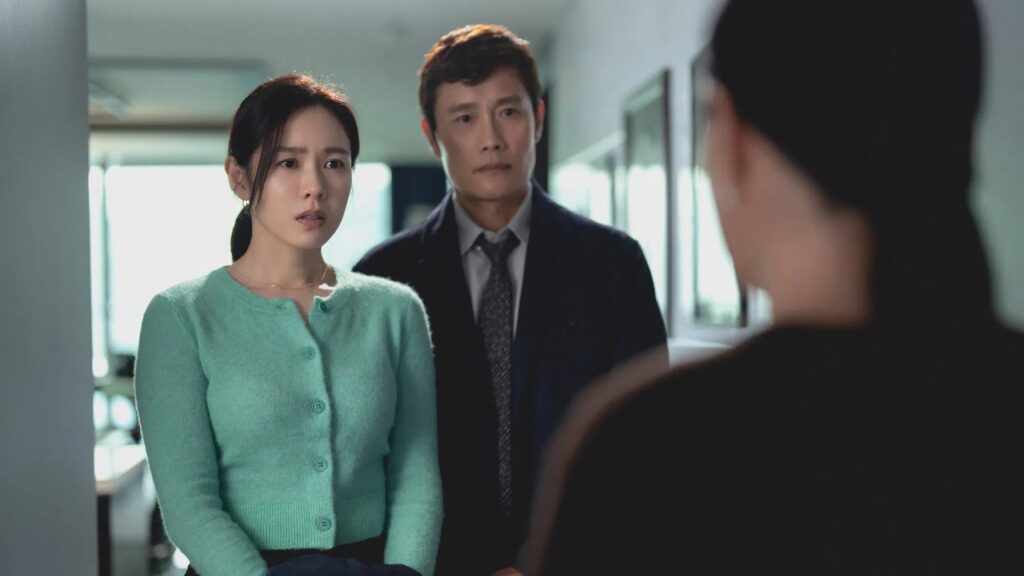
Chan-wook never loses sight of his how humane Man-su actually is; his daughter has never played cello in front of him or his wife, a connection he desperately craves, but what was once a united family that longed to connect deeper with their own daughter is now a broken family when Man-su finds himself growing distant with his wife who herself has sacrificed her hobbies and her job, finding work as a dental assistant in a young dentists practice, something that fills Man-su with jealousy and in turn causes a drift between him and his wife.
Not helped by his constant mysterious journeys that have him away from home for most of the day and late into the night, as he secretly goes out to get close to his competition, perhaps time he could use to get close to his family in such rough times.
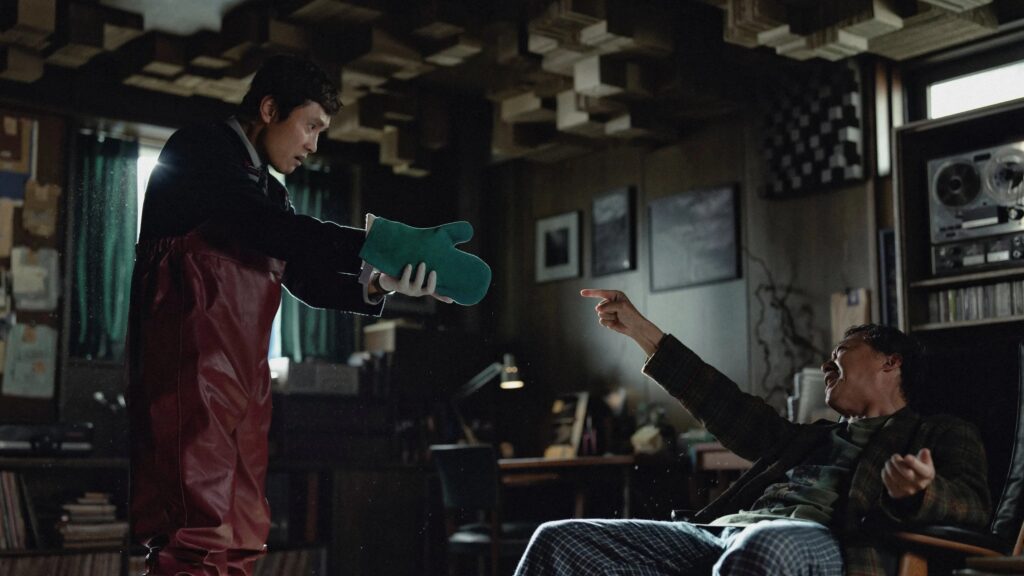
Man-su is a manager by trade, he knows how to talk to people and appease them, something he seems hilariously unable to do when it comes to his family, and he uses these skills to gain the trust of the men he seeks to eliminate, but such skills are not those of a killer. What becomes of these action scenes where Man-su shivers and shakes while holding a gun at someone’s head, overprotecting his hand by using three gloves as to not leave fingerprints to the point he can’t even move the finger to pull the trigger: again.
This movie is beyond hilarious. While he never gets any better at being an assassin, he does become a better father to his stepson Si-one when he himself, in an attempt to help alleviate the heavy financial and societal pressure his family is under, steals iPhones from his friends’ father store thanks to the influence of said friend. Lee Miri, who herself has been desperate to keep her life going, raise to children, and finding herself alone to do so thanks to Man-su’s mysterious escapades, attempts to seduce the man intent of pressing charges against her son, but Man-su’s fragile ego actually proves useful as a tool to look after his family, helping the bond between him and his wife as she finally gets a glimpse at the man she fell in love with.
However, there is an oppressively slow pace for the first hour of the film that ever so slightly bogs down what is otherwise an unhinged cascade down into a blackhole of murder and malice full of that one-of-a-kind Chan-wook style, the moments between Man-su’s attempts at getting a job the “normal way” feel unnecessarily long once his decision to eliminate the competition has been made, it doesn’t come across as a man struggling between doing what he knows or caving in to his dark passenger, but rather avoiding the inevitable pull of the trigger.
This nowhere near ruins the film, and the second half really brings it together when the focus is more on the effect his new darker self has on his family life, but it costs some of the flow of the narrative that otherwise wastes no shots and no moments, it simply takes a while for both darkness and comedy to take the reins and have one going: He’s done it again.
Park Chan-wook’s No Other Choice unnerves with slow-brewing tension and releases in macabre shock & gut-busting hysteria.
An unhinged descent into despair as the male ego is shattered & challenged and boy did Lee Byung-hun get the assignment. Mysterious & hilarious, an absolute treat of cinema.