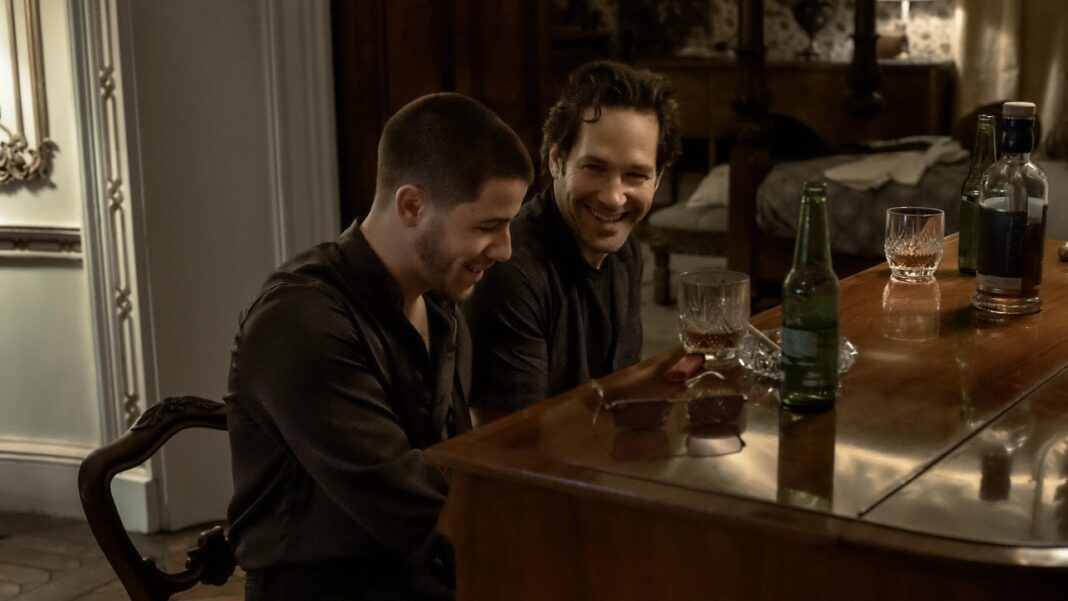

Go behind the scenes of John Carney’s Power Ballad as stars Paul Rudd and Nick Jonas dive into the grit, humor, and complex soul of music.

WARNING: SPOILERS FOR POWER BALLAD AHEAD.
Directed by John Carney, Power Ballad is a musical drama that explores the intricate, often tumultuous world of songwriting, artistic ambition, and the deep-seated human need for recognition. Centered around Rick Power, an aging rocker dad who plays in a wedding band, and Danny Wilson, a fading pop star desperate for his next big hit, the film pivots on a singular, brilliant song that brings them together – and ultimately divides them.
To mark the global rollout of the film, a series of three global press conferences were held, hosted by moderator Joe Utichi. The panels featured co-writer, director, producer, and songwriter John Carney, alongside the film’s two lead stars, Paul Rudd and Nick Jonas. Mama’s Geeky was in attendance and even had a couple of questions featured.
Over the course of the conversations, the trio discussed the reality of filming in the deeply musical city of Dublin, the creation of the movie’s central song, and how the narrative explores plagiarism not as a black-and-white legal thriller, but as a deeply human conflict. The creators also pulled back the curtain on the collaborative nature of the set, the classic wedding songs that didn’t make the final cut, and the personal musical memories that still hit them to their core.
Director John Carney Press Conference Highlights
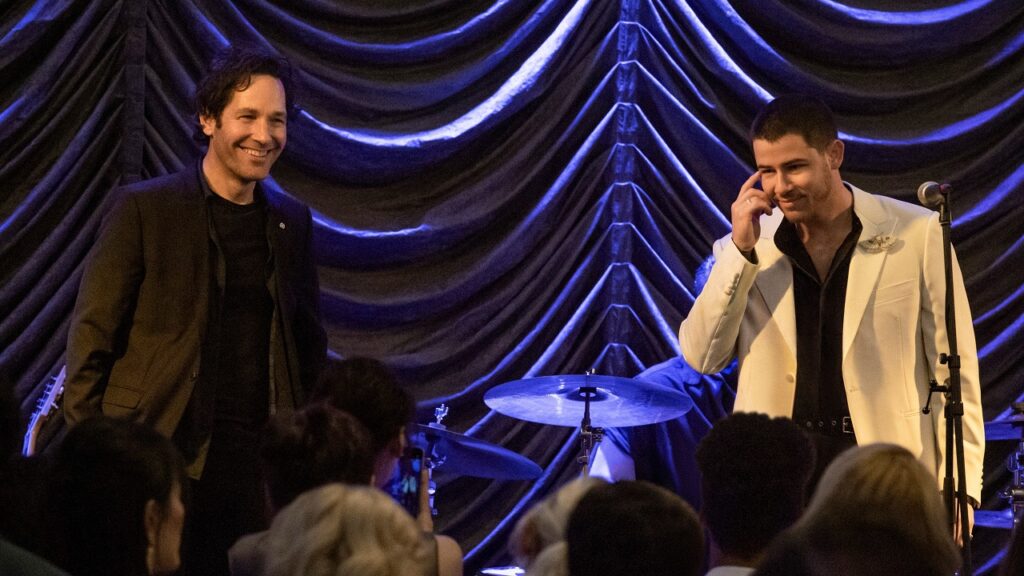
Director John Carney spoke candidly about his unique niche in filmmaking, referring to his career as a “small little racket” and a “rickety stool” built with love. Carney elaborated on his songwriting partnership with Gary Clark, how his own habits as a restless writer drive him from the laptop to the piano, and the nuanced way he and his co-writer Peter handled the sensitive theme of song plagiarism in the movie.
Question: Mark Tio is covering for Spain. He says that the title, How to Write a Song Without You, feels like it could be the film’s thesis. When you and Gary Clark are writing together, how do you know when a song has earned its place in the story? And when is it just a good song?
John Carney: That’s a really good question. I think that myself and Gary now have worked on three or four projects together, and I think we kind of finish each other’s sentences musically a little bit. Well, he improves my sentences, but we both know kind of where we want to go with these things. And it was Gary’s great lyric. That’s his lyric. And How to Write a Song Without You comes after the movie. And I think he was just hit by that nice little poetic moment where it’s like the older we become, we’re not writing songs, you know, for people anymore because we’re married or we have kids and we have mortgages to pay. And it’s our job. But how do we continue to do it if the person that we started with isn’t there? And I find that a very interesting question. And you’re right. I think it kind of taps into the whole idea of the movie, which is like family and kids and, you know, like that. You know, you know why you’re writing songs when you’re 20. It’s pretty straightforward. You know, you’re trying to get the girl or get the guy. You’re trying to punch the air. You’re trying to tell people in school to go screw them. You know, this pretty simple dynamics. They become a lot — They should become a lot more, you know, complex as you get older. And, you know, so we were writing more about how do I continue this job of songwriting now that I’m married and I have mouths to feed? And it’s an interesting idea, I think.
Question: Rodrigo Fonseca is coming from Brazil. Why is music such an essential part of your storytelling?
John Carney: Well, if I was to pan my laptop left or down, you would see guitars at every, you know, every angle of my life. And I basically, to answer your question, I work at that desk on the laptop and I get bored. I have a very low threshold for pain and I have a low attention span or poor attention span. So I push myself away from that in anger and I end up over here at my piano. And I found this nice balance between the two things. It satisfies the kind of the restless student that in school it was always getting given out to. I couldn’t sit still for four hours. It’s crazy. And I still can’t write a script for longer than 20 minutes at a go. And I find this way to kind of merge the two or meld the two into each other. And it’s a lovely, it’s a very happy place for me to go from the laptop to the piano back to the laptop. And that’s my only answer for you. I didn’t plan it this way. I was going to be Ingmar Bergman or something like that. But c’est la vie.
Question: Judita DaSilva covers for the U.K. and Nigeria. She asks, when mapping out the narrative arc of the film, knowing that with a story like this there will be those who want justice for your protagonist and there will be those that want the film to reflect the realism of the music industry, where some writers often get their music stolen, how did you decide the best way for the story to play out, both narratively and cinematically?
John Carney: Wow, that’s a good question. Let me think about that for a second ’cause it’s quite important. I think it was really important that there wasn’t a good guy and a bad guy in the movie. Because I’d like to go and see somebody making a movie about a thieving song guy getting his comeuppance. I’d happily see that movie. But I just wouldn’t be able to write it, I don’t think, because I don’t believe that music theft, or whatever, is that black and white. Like, I don’t think anybody sits down and knowingly steals in music. I think it’s just so much more complex than that. And once myself and Peter, who co-wrote the script with me, decided we weren’t going to be hard on any of the characters, we weren’t gonna say this is a bad guy who’s, like, planning and mustache twirling. He’s a young guy. You know, he’s just slightly differently made than the Rick character. But lets not beat him up, and let’s not have a big scene at the end where the judge goes, you’ll pay two million dollars in damages and, you know. You know, it’s not In The Name of the Father. It shouldn’t be a legal thing. Those movies are very satisfying, but that’s the other thing. There is no answer to this, you know.
Paul Rudd Press Conference Highlights
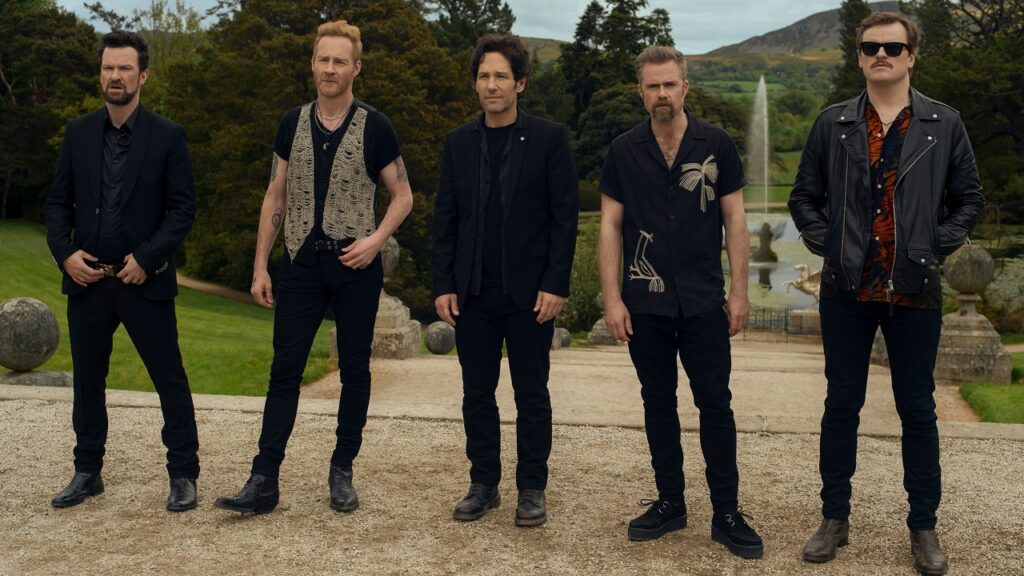
Paul Rudd stepped into the boots of Rick Power, channeling a lifetime of personal rock star fantasies into the role. Rudd opened up about his deep connection to Ireland, how he uses humor to navigate dramatic beats, and the highly collaborative environment fostered on set by John Carney. He also reflected on his sprawling career, noting how projects like Wet Hot American Summer, Anchorman, and his entry into the Marvel Cinematic Universe served as major turning points.
Question: Tessa Smith is covering for the US. The thought that every song means something different to different people is so true and relatable. What’s a song that you hold close to your heart?
Paul Rudd: Oh, boy. I mean, there’s just, oh, God. Here’s one that will surprise you. Anchors Aweigh. It’s a naval song. My father spent a few years in the Navy. When I was a little kid, sometimes he’d put me to sleep. My mom would sing me lullabies. But my dad would tell me stories. He’d make up stories. Because he didn’t sing. But occasionally, he would sing to me. But he didn’t really know any songs. So, he would sing Anchors Aweigh when I was a kid to put me to sleep. So, whenever I hear Anchors Aweigh, which is not often. It’s like, I remember when my dad used to sing me Anchors Aweigh. It’s a weird lullaby.
Question: Danielle Solzman from the U.S., covering for the U.S. Did Power Ballad require a different kind of restraint from you compared to other comedies you’ve done given the mix of music, humor, and emotional stakes?
Paul Rudd: It’s weird. I don’t think in terms of humor or comedy or drama. I don’t think I approach certain things differently. I mean, each role requires what it requires, I think, and the script was written. I knew exactly what Rick was gonna do. I knew that he spins out. So, I’m not really thinking in terms of comedy or drama. I think, you know, these things, they coexist. I deal with my own personal insecurities or stresses or traumas or whatever through humor. And I think I probably infuse that in most roles that I play. But I also infuse the humor when I’m trying to convey something dramatic, ’cause it’s what I do in life. But I just wanted to play the truth of what the guy was feeling in each moment, and that’s all I can really focus on.
Question: Paul Salfen, who’s covering for the US. “What do you keep in mind that keeps you on the right path and picking great films like this? What gets the green light from you now after those lessons have been learned, I guess?”
Paul Rudd: Well, you know, it’s never really changed. It’s, would I wanna see it? If I read something, it’s just kind of, would I wanna see this? That’s the first thing. Second, like, is there something about it that really resonates with me, that I’m drawn to? And it’s like, oh, I think this would be fun to play. Usually, you can tell when you’re reading it, like, you’re imagining doing it. You’re imagining how you would kind of tackle a role. Like, I think about that. And sometimes as I’m reading, I’m like, oh, I think I’m gonna wanna do this. I think this is gonna be one I’d really love to. Or I’ll read something and think, like, I’d love to be able to get my hat in the ring on this one. It doesn’t work out, but this would be one I’d love to try. You know, how they turn out is a completely different thing. You know, I go into just about every single thing I’ve ever done, and I’ve gone in with, “Like, this could be great.” Like, I really have an optimistic point of view about it. And they don’t always turn out, and that can be a little demoralizing or a lot demoralizing. But I don’t think of the success really in box office. I think of it in terms of what I gained from it personally, if there are some people that respond to it, and also, what the experience was like in making it. Because a movie could really just be terrible. You watch it, and it’s like, that movie sucked. It wasn’t funny. It wasn’t moving. It wasn’t anything. And I’m not getting those two hours of my life back. But when you’re filming a movie, it’s about three months. And it’s like, I’m gonna be in this place, possibly away from my family. I’m gonna be working with people who, like, you know, I’m gonna be spending a lot of time with. And so the experiences themselves, they do count for a lot. I’ve had some really, really great experiences. I mean, predominantly great experiences working on things. But the thing that really is the North Star for me is, would I wanna see it? And is there something within me that is drawing me to trying to tackle the role?
Nick Jonas Press Conference Highlights
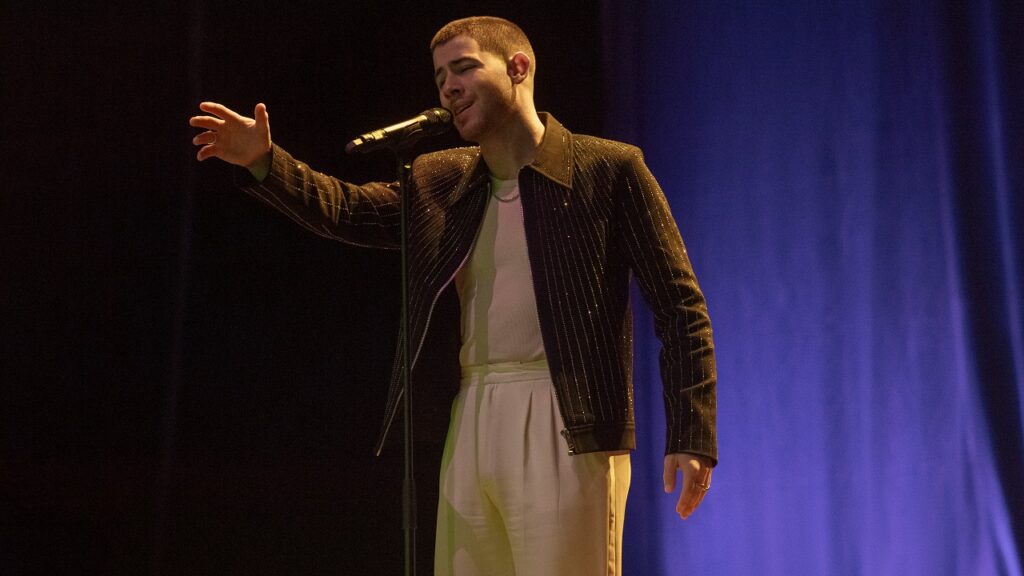
Nick Jonas brought his extensive real-world musical background to the character of Danny Wilson, drawing on a transitional period in his own career around 2014 and 2015 when the Jonas Brothers had split. Jonas discussed the unique dynamic between the film’s two leads, noting that Rick and Danny are on parallel paths to prove they are enough. He also noted how his songwriting foundation informs his acting, viewing the creative process in both spaces as one big math problem to be solved.
Question: Tessa Smith now covering for the US. I so badly wanted to see Danny come clean during that final concert performance that we saw. Did you ever want that for him?
Nick Jonas: Of course. Yeah, I mean, I think, you know, I imagine that he does before the scene where we see Paul throw the money into the busker’s open guitar case. My theory is that he does do the right thing. And perhaps that’s not he comes clean publicly, but he makes it right with Rick, you know, both financially, but also emotionally. And maybe there is an amendment to the credits on Spotify and everything else, but, you know, it’s fun to play that game. And I hope audiences, when they watch the movie, when they’re sitting around having their glass of wine after are debating what they think, you know, happened.
Question: Gonzalo Lira now covering for Mexico. Your character is not a villain but he is an antagonist. What was the most important thing for you to keep him grounded and believable?
Nick Jonas: Well, I think it was actually pretty easy because I’ve seen scenarios play out, you know, not to the level that it escalates to in the film, but versions of an idea got started, someone else finished it months later, forgot where they had heard it or where it had originated from. And then you look up and things get sideways, right? And other scenarios where you very unintentionally can land on a similar melody. There’s only so many notes on the keyboard and there’s only so many melodies and words to choose from that, you know, when there’s thousands of songs being written every day by all the people around the world writing music, something’s bound to happen. And that’s what really drew me to this project and this idea that we don’t have to position Danny as some evil villain. He could just be a guy who made a bad decision and then also probably didn’t even realize as it was happening, what was going on, you know? And I love that aspect of it. And it just complicates the story further and makes it way juicier.
Question: Johny Hoque, who’s covering for Bangladesh. The film shows both the glamour and the pressure of the music industry. What do you think Power Ballad says about the cost of staying relevant in today’s entertainment world?
Nick Jonas: That’s a good question. I think it’s an ever-changing landscape and, you know, even just in the last five years with the introduction of TikTok and the way that it’s changed how people consume music and how music trends begin and, you know, the fact that there are certain ways in which you have to write music to cater to that algorithm. There’s all these things that have just, you could look at it and say, have complicated it or you could look at it and go, well, there’s an opportunity there. You know, I tend to lean towards the evolve or get left behind mentality and the way in which I approach the use of social platforms like that and others that have changed the musical landscape and charts and all that. So the pressure can be pretty intense or you can find new collaborators to work with who help you open up a new lane. You can look at how to better engage with your audience more directly, you know, and understand that these platforms create an opportunity to make a very big world a little smaller. And perhaps the better thing to do is to look at audience depth and not range, you know, if that’s the move, and really building a fan base that is super dedicated and engaged. And the days of sort of mass appeal for music as a whole are a little more complicated. And that’s just by nature of how these things are set up. But that pressure doesn’t drive me. It’s sort of just an acknowledgement and then it’s a pivot to how can we make an impact? How can we find a way to cut through? And I think that, you know, the film industry is a good example of, especially right now, what an exciting time it is. You know, on one hand you have big tent pole studio projects that are crushing it. And then you’ve got obviously things like Backrooms and Obsession that are made on a smaller budget by Internet creators at first, YouTubers who then transition and become massive film directors. It’s a really exciting time, both as an actor, a producer and a lover of film to just be looking at how that’s changing and how it feels like we’re in a sort of a Renaissance era. And it’s really encouraging.
About Power Ballad
When Rick (Paul Rudd), a past-his-prime wedding singer, meets fading boy-band star Danny (Nick Jonas) during a gig, the two bond over music and a late-night jam session. But when Danny turns one of Rick’s songs into the hit that reignites his career, Rick sets out to reclaim the recognition he believes he deserves – even if it means risking everything he cares about.
Power Ballad played at SXSW 2026 and is in theaters now.